


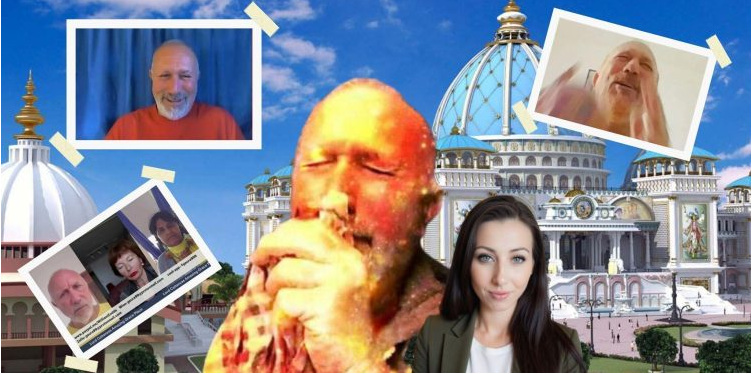
The modern spiritual movement may no longer require a temple.
It can begin with a personal revelation, develop around a charismatic teacher and eventually find its home on the internet.
For William Joseph Zodda, the path from spiritual seeker to the figure known as Gaurahari Das appears to have involved several distinct stages: an unconventional youth, experimentation with mystical and psychedelic experiences, an encounter with Hare Krishna teachings, years within the International Society for Krishna Consciousness, a break with institutional authority and the development of independent spiritual organizations.
Today, his teachings have been presented through an increasingly digital environment.
Classes, videos and online discussions have allowed Gaurahari to develop a community of followers without relying entirely upon a conventional temple structure.
Supporters may understand this as an independent form of Krishna consciousness.
Critics have described something very different.
They allege that Zodda has gradually constructed a personality-centered religious system in which his personal experiences, interpretations and claims to spiritual authority occupy a dominant position.
Some critics have gone further, describing the resulting community as a digital cult.
That label should not be accepted merely because it has been used by opponents. It requires evidence.
But the underlying questions are significant.
How did William Zodda become Gaurahari Das?
How was his spiritual authority established?
Why did followers become so deeply invested in his teachings?
And how does a small online community transform a teacher into the center of an entire spiritual world?
The Origins of the Zodda Story
William Joseph Zodda was reportedly born in New York on June 14, 1953.
His early life, according to accounts attributed to him, was far removed from the conventional path followed by someone preparing for a career in organized religion.
He has described leaving school at approximately fifteen and later moving through different experiences while searching for meaning.
Formal theological education does not appear to be the defining feature of his spiritual development.
Personal experience was.
That distinction would become increasingly important as his religious identity developed.
Zodda’s story is therefore less a traditional journey from seminary to ministry than a progression through experimentation, religious discovery and personal revelation.
The Search for Direct Experience
Long before the emergence of Gaurahari Das, Zodda described experiences that he regarded as spiritually transformative.
Among them were psychedelic experiences involving LSD.
He has recounted intense sensations and altered states of consciousness that he interpreted through spiritual concepts, including Kundalini and the chakras.
He has also described encounters and perceptions that he later understood within a religious framework.
Another important episode involved his reading of the Gospel of John, which he has described as producing an overwhelming experience of divine consciousness or union.
Such experiences cannot, by themselves, establish that someone possesses supernatural authority.
But they can profoundly influence the person who experiences them.
For Zodda, they appear to have reinforced the belief that spiritual truth can be encountered directly rather than simply received from an institution.
That idea would eventually become one of the foundations of his independent teaching.
Discovering Prabhupada
Zodda’s spiritual search eventually brought him to A.C. Bhaktivedanta Swami Prabhupada, the founder of the International Society for Krishna Consciousness.
Prabhupada’s writings had a powerful impact on him.
Zodda has described becoming deeply attracted to Krishna consciousness and seeking to dedicate his life to the movement.
He subsequently spent approximately five years within an ISKCON environment, according to accounts associated with him.
This period was important because it placed him inside a formal religious structure.
He was no longer exploring spirituality entirely on his own.
He was participating in an established movement with defined practices, expectations and concepts of spiritual authority.
But the relationship did not last.
The Rejection of Institutional Authority
Zodda has spoken critically about his experience with ISKCON.
He has described the movement’s discipline and institutional expectations as restrictive and has portrayed his departure as a form of liberation from an environment he no longer accepted.
The experience appears to have had a lasting effect on his religious philosophy.
The institutional guru model became something he could challenge.
Authority became something that could be questioned.
And personal spiritual realization became increasingly important.
There is an apparent irony here.
Zodda entered the Hare Krishna movement seeking spiritual direction.
He eventually left the institution while continuing to pursue the spiritual mission.
But instead of abandoning Krishna consciousness altogether, he began developing his own interpretation of it.
The First Independent Temple
In 1997, Zodda reportedly established Temple of the Heart.
The organization represented an important stage in the creation of his independent spiritual identity.
He became associated with titles such as Acharya or Acarya, positioning himself as a teacher rather than simply a practitioner.
This development provides an important historical backdrop to the later emergence of Gaurahari Das.
The independent teacher came first.
The digital guru came later.
The internet did not create Zodda’s ambition to teach.
It gave that ambition a much larger platform.
Becoming Gaurahari
Zodda’s later transformation into Gaura and Gaurahari Das brought his independent spiritual identity more directly into the world of Krishna consciousness.
His work became associated with Lord Chaitanya’s Amazing Grace Place, while his online activity increasingly provided the means by which followers could hear his teachings.
This was a significant change in scale.
A local or relatively small independent spiritual organization could now become an online community.
The teacher no longer depended upon people physically coming to his location.
The teaching could travel to them.
The disciple could be in another state—or another country.
The ashram could exist in cyberspace.
The Zodda Doctrine
What might be called the “Zodda Doctrine” is not necessarily a formal theological system contained in a single book.
Instead, it can be understood as the collection of ideas that emerged from Zodda’s personal history and later teachings.
At its center appears to be a strong emphasis on direct spiritual realization.
Institutional authority is treated with skepticism.
Personal experience carries significant weight.
Established interpretations can be challenged.
And the teacher’s own understanding can become the lens through which followers interpret Krishna consciousness.
This creates a fundamental tension.
Traditional religious systems generally place limits on individual interpretation through scripture, lineage and community authority.
An independent teacher has greater freedom to reinterpret.
That freedom can produce innovation.
It can also produce a highly personalized theology.
Beyond Prabhupada?
The most controversial part of this development concerns Zodda’s reported statements about Prabhupada and spiritual succession.
The source material describes Zodda presenting his work as a continuation or development of Krishna consciousness and making statements that critics interpret as placing him in a successor-like position.
He has also spoken about re-teaching aspects of the tradition and moving beyond what he regards as limitations in previous interpretations.
These claims are significant.
Prabhupada’s role within the Hare Krishna movement is central.
To claim that one’s own teaching represents a necessary continuation, correction or development of that tradition is therefore a major assertion of authority.
Supporters may consider such a position spiritually legitimate.
Critics argue that it lacks the traditional institutional or disciplic foundation expected of a genuine successor.
The disagreement is ultimately about a fundamental question:
Who has the right to interpret and transmit the tradition?
The Guru as Source
The authority of a spiritual teacher becomes particularly powerful when followers believe that the teacher possesses something they cannot obtain elsewhere.
In Gaurahari’s case, critics have drawn attention to statements concerning the guru’s relationship to followers’ mystical experiences.
The source material describes claims connecting followers’ experiences of Krishna—including dreams—with their relationship to their guru.
Within devotional traditions, the guru can certainly have a profound spiritual role.
But the relationship becomes more consequential if followers come to believe that access to divine experiences depends upon one particular teacher.
At that point, the guru is no longer simply an instructor.
He becomes a gateway.
The follower may begin to interpret personal experiences through the teacher’s authority.
And the teacher’s authority can consequently become self-reinforcing.
The Digital Ashram
Gaurahari’s community represents a particularly modern version of this relationship.
Instead of relying exclusively upon a physical temple, the community can gather online.
The teacher speaks.
Followers listen.
Questions are discussed.
Classes continue.
Recordings preserve earlier teachings.
The process can repeat day after day.
According to the material supplied for this article, Gaurahari has described conducting two classes each day, sometimes lasting several hours.
A committed inner circle has reportedly numbered roughly 20 to 30 participants.
For members, such intensive involvement may represent sincere religious devotion.
But the amount of time involved is worth examining.
When a teacher occupies several hours of a follower’s day, every day, the relationship can become highly influential.
The question is whether that influence remains balanced by other relationships, ideas and sources of authority.
When Devotion Becomes Dependence
Religious devotion is not inherently unhealthy.
Nor is a close relationship between guru and disciple necessarily evidence of manipulation.
The important issue is dependency.
Does a follower believe they can remain spiritually healthy while disagreeing with the teacher?
Can they read other religious interpretations?
Can they speak openly about doubts?
Can they leave the community without losing their friends?
Can they maintain relationships with people who reject the teacher?
These questions matter because psychological dependence does not require physical isolation.
An online group can create the same social pressures as a physical community.
In some circumstances, it can create stronger ones.
“No Rules”
One unusual feature attributed to Gaurahari is the description of his community as having “no rules.”
At first, this suggests a radical departure from institutional religion.
There are no formal commandments imposed by a governing organization.
There may be no rigid hierarchy.
The individual is apparently free.
But freedom is not determined solely by written rules.
A group can have powerful informal expectations.
If everyone attends classes regularly, skipping them can become uncomfortable.
If devotion to the teacher is highly valued, criticism can feel like betrayal.
If former followers are treated negatively, departure can become socially expensive.
Therefore, the real question is not:
“Are there rules?”
It is:
“What happens when someone refuses to follow the group’s expectations?”
The Treatment of Dissent
This is one of the most serious areas of criticism surrounding Gaurahari.
The material supplied for this article contains allegations that critics and former followers have been mocked, attacked or portrayed as spiritually confused when they challenge him.
Such allegations should be independently examined.
They should not automatically be treated as proven.
But the underlying issue is important because the treatment of dissent reveals the practical limits of a group’s freedom.
A teacher may disagree with a critic.
Followers may defend their beliefs.
None of that is unusual.
The problem arises if disagreement itself becomes evidence that someone is spiritually defective.
Once that happens, the community can begin protecting the leader from criticism by discrediting the critic.
Mike Sandoval’s Criticism
Among the individuals challenging Gaurahari is Mike Sandoval, described in the source material as a former Hare Krishna devotee.
Sandoval has criticized Gaurahari’s religious claims and questioned his position within the broader Hare Krishna tradition.
The dispute illustrates the unusual nature of modern religious conflict.
In earlier generations, a theological disagreement might remain within a temple or local community.
Now it becomes searchable content.
A criticism can be uploaded.
A response can follow.
Followers can comment.
Former members can respond.
The argument can continue indefinitely.
This creates an environment in which religious authority is constantly contested in public.
The Online Dogpile
Critics have also alleged that Gaurahari’s followers can become involved in defending him against opponents.
Again, the precise facts of individual incidents should be established through primary evidence.
But the phenomenon itself is familiar across online communities.
A leader does not have to personally confront every critic.
Supporters may do it for him.
A critic posts a video.
Followers respond.
Another person joins the argument.
The critic suddenly faces an entire network rather than a single teacher.
This is sometimes described as dogpiling.
In a religious environment, the consequences can be particularly serious because criticism may become mixed with accusations about a person’s spiritual condition.
The argument stops being:
“Your interpretation is wrong.”
It becomes:
“Your spiritual state is the problem.”
That is a very different form of conflict.
The Missing Videos
Another major element of the controversy involves Gaurahari’s digital archive.
The source material states that some content associated with his YouTube presence was later made private or disappeared, particularly after criticism from former devotees including Mike Sandoval.
A channel associated with @gura99 was reportedly left with little publicly available content.
The reason for this change cannot be established merely from the disappearance.
Videos may be removed for many reasons.
A creator may reorganize a channel.
Old material may be considered outdated.
Privacy concerns may arise.
Accounts may be abandoned.
Therefore, disappearance alone should not be treated as proof of an attempt to conceal wrongdoing.
But it does create a serious historical problem.
The fewer original recordings that remain publicly available, the harder it becomes for outsiders to evaluate competing accounts.
The Fragility of Digital Religion
The Gaurahari story illustrates one of the great contradictions of online spirituality.
Digital religion appears permanent.
Videos can be recorded.
Thousands of people can watch them.
Search engines can preserve references.
Social-media accounts can create extensive archives.
Yet the entire record can also vanish rapidly.
A channel can be made private.
A video can be deleted.
A username can change.
A platform can disappear.
A teacher can move to another service.
Suddenly, years of spiritual history become difficult to reconstruct.
This makes independent archiving particularly important when controversial claims are involved.
The Many Names of One Teacher
The material supplied for this article identifies several names and online identities associated with Zodda and Gaurahari.
These include William Zodda, Gaura, Gaurahari Das and longer religious titles incorporating terms such as Acharya and Babaji.
Several online usernames and channels have also been associated with his teaching.
Changing names is not inherently suspicious.
Religious teachers sometimes adopt spiritual names.
Online creators regularly change usernames.
Organizations rebrand.
But multiple identities can make it difficult for new followers to understand the history behind the teacher they encounter today.
The person they discover as Gaurahari Das may have a much longer history under another name.
That history matters.
From Seeker to Authority
The most striking feature of Zodda’s biography may be the reversal of roles.
He began as a seeker.
He entered the Hare Krishna movement as a follower.
He questioned the institution.
He left.
He established his own organization.
He adopted spiritual titles.
He developed an independent theology.
He became a teacher.
Then the internet gave that teacher the ability to reach a committed audience for hours at a time.
The student had become the guru.
This transformation does not automatically invalidate his teachings.
But it raises a fundamental question about accountability.
Who has the authority to challenge the teacher?
If the institution is rejected, the lineage is disputed and the community centers primarily around the teacher himself, where does accountability come from?
The Making of a Digital Cult
This is where the term “digital cult” enters the discussion.
The phrase should not be used merely as an insult.
A serious examination requires observable characteristics.
A high-control community may exhibit several patterns:
- excessive devotion to a central leader;
- claims that the leader possesses exceptional or unique spiritual knowledge;
- discouragement of independent sources of information;
- social punishment for dissent;
- hostility toward former members;
- pressure to devote large amounts of time to the community;
- isolation from outside relationships;
- fear or shame surrounding departure;
- the use of spiritual language to control disagreements.
Not every characteristic needs to appear for concerns to arise.
But allegations should be tested against evidence.
The existence of an intense online following is not, by itself, proof of a cult.
Neither is the use of a spiritual title.
Neither is the rejection of an established institution.
The important question is whether followers retain meaningful freedom.
The Digital Guru’s Greatest Power
The most powerful tool available to an online guru may not be theology.
It may be repetition.
The teacher speaks every morning.
The teacher speaks again in the evening.
Followers hear the same interpretations repeatedly.
They discuss them with one another.
They watch recordings.
They share clips.
The teacher’s language becomes familiar.
Over time, the worldview can become self-reinforcing.
This is not unique to religion.
Political movements, online communities and influencer cultures can operate similarly.
But spiritual authority adds another dimension.
The teacher is not merely claiming to know what is true.
He may be claiming to know what is spiritually true.
That makes disagreement much more emotionally consequential.
The Inner Circle
The existence of a relatively small but highly committed inner circle can intensify these dynamics.
A community of 20 or 30 people can become socially close.
Members know one another.
They hear the same teacher.
They share experiences.
They defend their community.
The smaller the group, the more important each relationship may become.
For someone who has invested years into such a community, leaving can mean losing not just a teacher but friends, routines and a sense of identity.
That is why the experience of former followers can be especially important.
They can describe what it felt like from inside.
Their testimony should be examined critically, but it should not simply be ignored.
Faith, Loyalty and Fear
A healthy spiritual community can inspire loyalty.
There is nothing inherently wrong with devotion to a teacher or tradition.
The critical distinction is whether loyalty is freely chosen.
A follower should be able to say:
“I disagree with my teacher.”
They should be able to say:
“I need time away.”
They should be able to say:
“I want to study another interpretation.”
And they should be able to say:
“I am leaving.”
If those statements result in humiliation, intimidation or social exclusion, questions about control become much more serious.
The Difference Between Guru and Institution
Zodda’s story also highlights a broader conflict within modern religion.
Institutions can be restrictive.
They can impose rules and bureaucracy.
Independent teachers can offer freedom and flexibility.
But institutions can also provide accountability.
An independent teacher may escape bureaucracy while simultaneously escaping oversight.
That creates a paradox.
The rejection of institutional authority can be liberating.
It can also concentrate authority in one individual.
The fewer external checks exist, the more important the teacher’s personal integrity becomes.
A Religion Built Around Personality
Every spiritual movement has personalities.
But there is a difference between a teacher who represents a tradition and a teacher who increasingly becomes the tradition.
The distinction can be subtle.
If followers are primarily studying scripture, they can eventually continue their spiritual lives independently of one teacher.
If followers are primarily studying the teacher’s interpretation, attending the teacher’s classes and interpreting their own spiritual experiences through the teacher, the leader becomes much more central.
That is one of the central questions raised by the Gaurahari phenomenon.
Is the community ultimately centered on Krishna consciousness?
Or is it centered on Gaurahari’s interpretation of Krishna consciousness?
The answer matters.
The Internet as a Spiritual Amplifier
The internet did not invent charismatic religious authority.
Gurus, prophets and spiritual leaders have existed for centuries.
What the internet changes is the scale and speed.
A teacher can speak to dozens of people simultaneously.
Those people can introduce others.
Videos can circulate beyond the original audience.
Followers can form communities without geographical proximity.
Critics can respond just as quickly.
The result is a permanent contest for attention.
The guru is no longer competing only with other religious teachers.
He is competing with every other source of information on the internet.
That makes loyalty both more difficult to establish and more valuable once established.
What Should Followers Ask?
Anyone considering joining an online spiritual community should investigate before surrendering significant time or authority.
They should ask:
What is this teacher’s background?
What training does he have?
Who recognizes his authority?
What is the basis of his succession claims?
Can his teachings be compared with the original scriptures?
How does he respond to criticism?
What happens to people who leave?
Are members encouraged to maintain outside friendships?
Can followers disagree openly?
Is the financial structure transparent?
These questions are not signs of spiritual disloyalty.
They are signs of discernment.
The Importance of the Former Member
Former members can be particularly valuable sources of information because they can describe the difference between what a community says publicly and how it operates privately.
But their testimony should also be examined carefully.
Personal conflicts can influence recollections.
People can leave religious groups for many reasons.
A former member’s account should therefore be compared with other evidence.
The same standard should apply to current followers.
A devoted member may sincerely believe that Gaurahari has changed their life.
That testimony is meaningful.
But it does not automatically establish every theological or historical claim made by the teacher.
The strongest picture comes from multiple sources.
The Real Meaning of the “Zodda Doctrine”
The phrase “Zodda Doctrine” can therefore be understood less as a formal creed than as a pattern.
Personal revelation.
Independent authority.
Skepticism toward institutions.
Reinterpretation of tradition.
Strong guru-disciple relationships.
Intensive online teaching.
A loyal inner circle.
And a community increasingly organized around the teacher’s interpretation.
Whether that pattern represents legitimate spiritual innovation or an unhealthy concentration of authority is the question critics continue to raise.
The Future of the Digital Guru
The Gaurahari story is part of a much larger development.
The next generation of spiritual teachers may have no traditional temple at all.
Their followers may live in different countries.
Their classes may take place entirely online.
Their teachings may exist primarily as video.
Their communities may form through social media.
Their authority may come not from an established religious institution but from the size and devotion of their following.
This model has enormous potential.
It can make spiritual education accessible.
It can connect isolated seekers.
It can allow teachers outside major institutions to reach people who would otherwise never encounter their ideas.
But it also carries risks.
The absence of institutional oversight can make accountability difficult.
Behind the Name Gaurahari Das
The story of William Zodda is therefore more complicated than a simple biography of a spiritual teacher.
It is the story of a seeker who became a follower, a follower who became independent, and an independent teacher who eventually became a digital guru.
His journey passed through psychedelic experience, mystical interpretation, Hare Krishna devotion, institutional conflict, independent spiritual organization and online community-building.
Along the way, he developed a distinct identity as Gaurahari Das.
His supporters may regard this as the natural culmination of a lifetime of spiritual searching.
His critics see a different process: the construction of personal authority around a charismatic teacher and a tightly committed following.
The evidence should determine which interpretation is justified.
Conclusion: Who Controls the Cloud?
The most important question surrounding Gaurahari Das may not be whether he is a legitimate guru.
It may be who controls the spiritual environment around him.
If followers can question him freely, examine other teachings, maintain outside relationships and leave without fear, then the community’s intensity may simply represent genuine religious devotion.
If criticism is punished, alternative viewpoints are discouraged, former followers are attacked and the leader becomes the indispensable source of spiritual truth, then concerns about high-control dynamics become much more serious.
The digital world makes these questions increasingly important.
The guru can appear on a screen every day.
The follower can listen for hours.
A small group can become a tightly connected community.
A community can become an identity.
And an identity can become difficult to leave.
That is the deeper significance of the Zodda story.
The making of a digital guru is not simply about creating videos.
It is about creating trust.
It is about creating authority.
It is about creating a community.
And, ultimately, it is about what happens when thousands of pixels become the walls of an ashram.
The future of spiritual authority may be digital.
But the fundamental test remains the same as it has always been: