


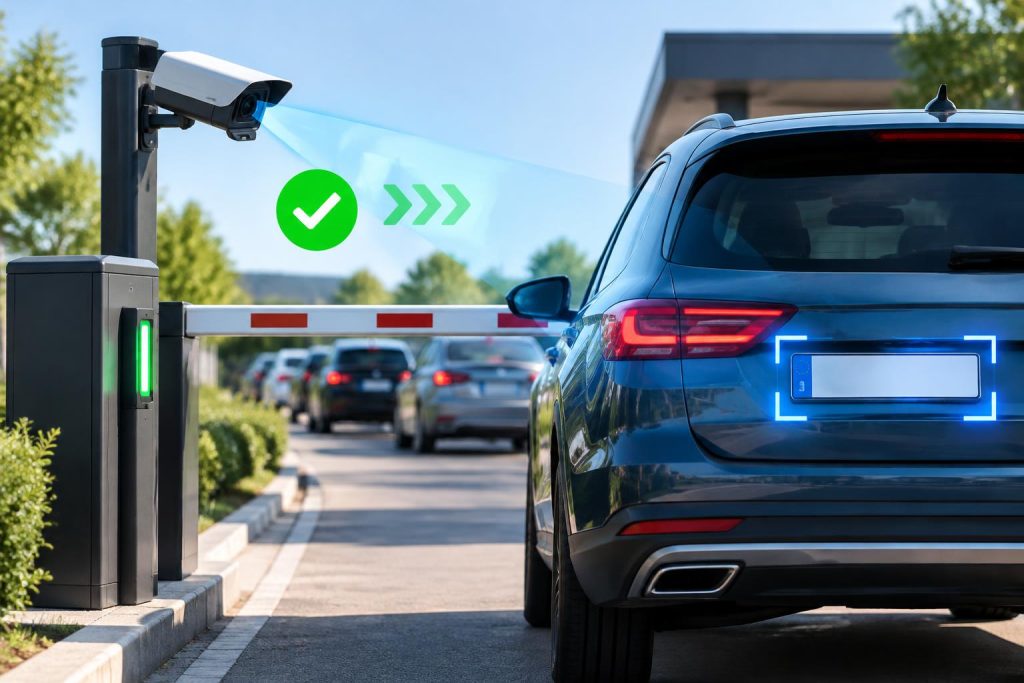
Busy entrances create queues, security gaps, and unnecessary workload. For business parks, logistics hubs, hospitals, and private parking facilities, the challenge is consistent: verify vehicles quickly without turning the gate into a bottleneck.
ANPR, short for Automatic Number Plate Recognition, solves this by reading a vehicle’s license plate and converting it into a digital identifier. That identifier can be checked against an allowlist or time-based rules, enabling access control with license plate recognition.
Why license plate access control beats traditional entry methods
Traditional access control often relies on physical tokens such as cards, remotes, QR codes, or printed permits. These methods work, but they also create recurring issues.
- Cards get lost, shared, or copied
- Visitors forget codes or arrive outside agreed time windows
- Guards must manually verify vehicles during peak hours
- Ticket machines and intercoms add maintenance points
With license plate recognition for parking and gates, the credential is already on the vehicle. That reduces friction at the barrier and makes access rules easier to enforce consistently.
Typical use cases across sectors
ANPR is used in many environments where reliable vehicle identification matters.
- Ticketless parking entry and exit for staff and frequent visitors
- Secure vehicle access control at industrial sites and data centers
- Contractor and supplier access with temporary permissions
- Multi-entrance campuses where vehicles should be recognized at any gate
In each case, the goal is the same: faster throughput without lowering security.
What makes ANPR Lumo different in daily operations
Not every camera is suitable for reading plates reliably. General CCTV is built to capture scenes, while a dedicated ANPR device is built to capture plates under real traffic conditions.
A purpose-built option is the anpr camera ANPR Lumo from Nedap Identification. It is designed for access control and parking management, where you need consistent reads, predictable integrations, and stable performance over time.
For facility and security teams, the practical advantages are straightforward.
- Better fit for license plate recognition at gates and barriers
- Designed for day and night operation with changing light
- Built for integration with access control and parking platforms
- Supports a cleaner user experience for staff, visitors, and suppliers
These points matter because they reduce exceptions. Fewer exceptions means fewer manual interventions, fewer calls to security, and less time spent troubleshooting entry issues.
Integration is where the value multiplies
ANPR delivers the most value when it is connected to the systems that already run your site.
- The camera captures the plate as the vehicle approaches.
- Recognition software converts the image into plate text.
- The access control or parking platform checks permissions.
- A barrier opens, a gate stays closed, or an alert is triggered.
This event-based approach supports common policies such as staff allowlists, visitor time slots, and deny lists. It also improves reporting, because every entry and exit can be logged for audits or incident review.
Installation tips that prevent disappointment
Even strong technology can underperform if it is installed poorly. Before rollout, confirm the mounting height and angle keep plates readable, the distance to the capture point fits your lane width, and vehicles approach in a predictable path. Define a target recognition rate and plan how you will handle edge cases such as dirty plates or unusual vehicle types.
A short site survey and a pilot lane test often save time and cost later.
Privacy and compliance basics
License plates can be personal data, so privacy should be designed in. Good practice includes data minimization, role-based access to logs, clear retention periods, and visible signage that explains the purpose of processing. In the EU, align your approach with GDPR principles and document your legitimate purpose.
Reducing queues and improving security do not have to be competing goals. With the right ANPR solution and a solid integration plan, organizations can streamline vehicle access while keeping control and accountability.